[{"term":"Libraries_BA","id":0,"type":"QUICKLINKS"},{"term":"Instructions","id":1,"type":"QUICKLINKS"},{"term":"WAGO-I/O-PRO","id":2,"type":"QUICKLINKS"},{"term":"Building","id":3,"type":"QUICKLINKS"},{"term":"221","id":4,"type":"QUICKLINKS"}]
{ "@context": "https://schema.org", "@type": "BreadcrumbList", "itemListElement": [ { "@type": "ListItem", "position": 1, "name": "Homepage", "item": "https://www.wago.com/ae" }, { "@type": "ListItem", "position": 2, "name": "Solutions", "item": "https://www.wago.com/ae/solutions" }, { "@type": "ListItem", "position": 3, "name": "Process Engineering", "item": "https://www.wago.com/ae/process-engineering" }, { "@type": "ListItem", "position": 4, "name": "Explosion Protection", "item": "https://www.wago.com/ae/process-engineering/explosion-protection" }, { "@type": "ListItem", "position": 5, "name": "Basics", "item": "https://www.wago.com/ae/process-engineering/explosion-protection/basics" } ] } [{"url":"/solutions","name":"Solutions","linkClass":null,"categoryCode":null},{"url":"/process-engineering","name":"Process Engineering","linkClass":null,"categoryCode":null},{"url":"/process-engineering/explosion-protection","name":"Explosion Protection","linkClass":null,"categoryCode":null},{"url":"/process-engineering/explosion-protection/basics","name":"Basics","linkClass":"active","categoryCode":null}]
Topics

Explosion Protection for Humans and Machines

The topic of explosion protection originated in mining. Mixtures of methane and air that arise in coal mining and are explosive in a certain ratio were handled with controlled explosions until the second half of the century. But how does it work now?

Flaring off firedamp is no longer necessary due to a number of technical achievements and protection regulations. However, the topic of explosion protection has not lost its importance despite all this. It is now widespread not only in mining, but also in other industries, because explosive materials are also present there. Common examples include the chemical industry, during the production of crude oil or natural gas and in the food industry.

Your Benefits at a Glance:

  • Economical system operation
  • Short start-up and service times thanks to modular concepts
  • Reduced operating costs thanks to maintenance-free and vibration-proof connection technology
  • Adjustments can be made quickly thanks to optimum form factor and versatility
An Explosive Mixture

Combined with oxygen, these substances create a “dangerous explosive atmosphere.” If hot surface or an electrical ignition spark occur, this quickly leads to a situation that must be prevented under all circumstances. This is because such an event has the potential to directly harm many people, not to mention the impacts on the environment or the production systems. Therefore, appropriate member states’ directives and the legislation based on it have now become well-established in Europe: the ATEX directives (Atmosphere explosible). These include the 1999/92/EC for plant operators and the 2014/34/EU (previously 94/9/EC) for equipment manufacturers. The most important equivalents of Europe’s ATEX on the American market are the appropriate articles for the “Hazardous classified locations” (HazLoc) of the NEC and CEC and the EAC Ex. Other important regulations include the EAC conformity process (Eurasian Conformity) for Russia, Kazakhstan and Belarus, which replaces the old GOST import processes and is very similar to the ATEX and CE.

Explosion Protection

A distinction is generally made between primary, secondary and tertiary explosion protection. The measures of the primary explosion protection are aimed at preventing or restricting the generation of explosive atmospheres. Secondary explosion protection measures are used to prevent the ignition of explosive atmospheres – i.e. to prevent potential ignition sources. The measures of tertiary explosion protection are used to mitigate impacts of an explosion, bringing them to near-harmless levels. As part of an hazard assessment, which must be performed by each plant operator, the operator must ask if – as part of the primary explosion protection – it is possible to replace potentially explosive material to prevent an explosion in the first place. If this is not possible, then the plant operator is asked to classify the plant depending on the hazard and to mark the access. The zone model is the most used method worldwide and is specified in 1999/92/EC. A classification into “Divisions” is often found in the U.S. and Canada.

WDP_116_Vorsicht explosiv_Kläranlage.png

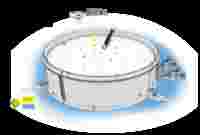
Explosive atmospheres are always present inside a tank – it is therefore an area of Zone 0. Control valves or exhaust vents are classified as Zone 1. Explosive atmospheres can occur here during normal operation. This does not normally occur in Zone 2 and, if it does, then only momentarily.