[{"term":"Libraries_BA","id":0,"type":"QUICKLINKS"},{"term":"Instructions","id":1,"type":"QUICKLINKS"},{"term":"WAGO-I/O-PRO","id":2,"type":"QUICKLINKS"},{"term":"Building","id":3,"type":"QUICKLINKS"},{"term":"221","id":4,"type":"QUICKLINKS"}]
[{"url":"/industries","name":"Industry Solutions","linkClass":null,"categoryCode":null},{"url":"/building-technology","name":"Building Technology","linkClass":null,"categoryCode":null},{"url":"/building-technology/lighting","name":"Lighting ","linkClass":null,"categoryCode":null},{"url":"/building-technology/lighting/customer-application-lighting-management-dali-led-lights","name":"Customer Application","linkClass":"active","categoryCode":null}]
Customer application

More Light, Lower Costs

When voestalpine, an Austrian technology and capital goods corporation, updated the lighting system at a central warehouse in Linz, Austria, the firm seamlessly switched to DALI-capable LED lights combined with proven WAGO Lighting Management. It was a great success: Based on the cost savings and the positive feedback from the workforce, they are already considering additional applications for WAGO’s solution.

Illumination is Often a Great Challenge

The illumination of warehouses and production facilities often entails a great challenge for manufacturers: The costs should be low, yet the lighting quality needs to be high in order to create optimal light conditions for the employees. If the economic aspects of lighting are prioritized, then energy efficient illumination must be considered in combination with an intelligent lighting management system.

The Austrian technology and capital goods company voestalpine has also been working on this topic for several years. The lighting control in the production facilities and warehouses has until recently been handled by using complex programs that were created for each building by external automation specialists and were linked to the specific demands for that site. The problem: The use of different programming languages that cannot communicate with each other has resulted in a situation in which centralized networking and control of the lighting systems are impossible. In addition, each new change in parameters requires knowledge of the programming language used. As the corresponding expertise is not always available to the necessary degree, the company depends on external service providers for more complex adjustments to the lighting technology.

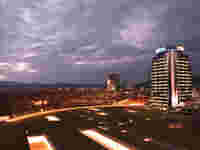
building_referenz_voestalpine_gebaeude_nacht_2_2000x1500.jpg

The automated lighting control in the production halls and warehouses of the technology and capital goods company voestalpine is handled by WAGO Lighting Management.

Selecting a Pre-Programmed Web Solution

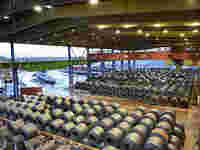
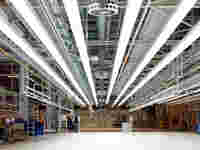
In the past year, the company went a step further and turned to a pre-programmed Web solution for their lights: WAGO Lighting Management. In the course of replacing the lighting in a central warehouse for steel rolls – each weighing several tons – the company chose to use automated lighting control in combination with the LED technology. Since then, the building in Linz, with an area of 5,400 m², has been illuminated by around 60 DALI-capable LED lighting units controlled by WAGO Lighting Management.

The challenges in this lighting management system are relatively straightforward in this initial project: It requires common, constant light control of all LED DALI lights with the aid of a brightness sensor in order to guarantee constant light levels at minimal energy consumption for all work shifts. The artificial light should automatically adapt to the natural light to optimally illuminate the building during every working hour, day or night. In addition, the individual operating modes, like “off,” “manual” and “automatic,” can be selected using a key-operated switch.

Lighting Management at voestalpine

  • Automated lighting control in combination with LED technology
  • 60 DALI-capable LED lighting units controlled by the WAGO Lighting Management
  • Constant light regulation of all LED DALI lighting units with the aid of a brightness sensor
  • Constant illuminance with minimal energy consumption
  • The hall is optimally illuminated at all times, day or night, during the work week

Start Up before Lunch

All elements associated with the lighting management were defined prior to start up. The individual DALI lights and the DALI light sensors were read into the system using the implemented scanning and addressing functions. The conventional digital inputs for the key-operated switch were automatically recognized, as they were part of the internal bus system. In the next step, the virtual rooms stored in the software were named according to their respective building components. All previously defined elements, like key-operated switches, electronic DALI ballasts and DALI sensors, were allocated to the virtual rooms and assigned to the “constant lighting regulation” function. Subsequently, a variety of parameters were defined, for example, monitoring parameters, and adjusted to the specific application. All commissioning, including the function test, was carried out in a single morning.

building_referenz_voestalpine_lagerhalle_1_2000x1500.jpg