[{"term":"Libraries_BA","id":0,"type":"QUICKLINKS"},{"term":"Instructions","id":1,"type":"QUICKLINKS"},{"term":"WAGO-I/O-PRO","id":2,"type":"QUICKLINKS"},{"term":"Building","id":3,"type":"QUICKLINKS"},{"term":"221","id":4,"type":"QUICKLINKS"}]
{ "@context": "https://schema.org", "@type": "BreadcrumbList", "itemListElement": [ { "@type": "ListItem", "position": 1, "name": "Homepage", "item": "https://www.wago.com/in" }, { "@type": "ListItem", "position": 2, "name": "Solutions", "item": "https://www.wago.com/in/solutions" }, { "@type": "ListItem", "position": 3, "name": "Railway Systems", "item": "https://www.wago.com/in/railway-systems" }, { "@type": "ListItem", "position": 4, "name": "Customer Application", "item": "https://www.wago.com/in/railway-systems/customer-application-sbb-train-stations-at-a-glance" } ] } [{"url":"/solutions","name":"Solutions","linkClass":null,"categoryCode":null},{"url":"/railway-systems","name":"Railway Systems","linkClass":null,"categoryCode":null},{"url":"/railway-systems/customer-application-sbb-train-stations-at-a-glance","name":"Customer Application","linkClass":"active","categoryCode":null}]
Customer application 27 August 2020

SBB Train Stations at a Glance

The control and error messaging system for the SBB (LSS-CH) replaces 23 different control systems with WAGO’s automation technology.
The SBB monitors the electrical systems at around 1,500 locations, like train stations and tunnels, throughout Switzerland. At the end of 2012, SBB commissioned a comprehensive control and error messaging system for this task to ensure a rapid and targeted response to malfunctions and faults.

Why WAGO?

  • More than 1,000 WAGO stations are being used successfully by the SBB.

  • A high degree of standardization can be achieved through configuration using the WAGO Webserver. 

  • Two standardized versions of the WAGO-I/O-SYSTEM, for 60 and 200 data points, make the start-up process faster.
Even before the first travelers arrive, the lights go on at many Swiss train stations. This also occurs at locations where no personnel are on site. In addition to lighting, there are other systems that the SBB must control and monitor, for example, elevators, escalators, clocks, door locks, building technology systems and pumps. Previously, around 23 different control systems, scattered across Switzerland, accomplished these tasks. In 2005, the SBB began a project to replace these different systems with a single new one. “We wanted to reduce the complexity and thus make the costs more transparent,” explains Milun Bozovic, Product Manager for Building and Control Technology at the SBB. At the end of 2012, they were ready: The control and error messaging system (LSS-CH for short) at the SBB became operative across the country following a four-year roll-out period.

railway_bahnhof_zug_2000x1125.jpg

Using the LSS-CH, the SBB controls railway electro-technical systems. These include ventilation, elevators, escalators, clocks, building technology systems, door locks and pumps.

A High Degree of Standardization

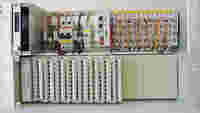
For on-site data recording, the SBB equipped around 1,500 locations with programmable logic controllers (PLCs) from WAGO. It puts each location into operation in the same way: The SBB prepares the controllers centrally; each PLC has the same software and the same references. The SBB then installs automation boxes and connects them to the control system via the SBB’s data network. This enables them to convert a location and put it into operation within one day. The locations have different sizes. Therefore, there are two different versions of WAGO’s controllers: The more data points a location has, the larger the WAGO Controller must be. The small controller is designed for 60 data points, the large one for 200. Bozovic explains: “We install pre-assembled automation boxes. However, they have a very flexible design, so that they can be supplemented with additional modules as needed.” WAGO’s controllers are normally programmed with CODESYS. However, since each stationmaster must be able to operate the controllers, the engineers installed the Webserver on the WAGO Controller. This allows configuration using a browser and the graphical interface. This achieves a high degree of standardization. Milun Bozovic adds: “The train stations are all different. But they have similar systems that have to be monitored. Lighting, clocks and pumps are present everywhere.” There are currently six 24-hour locations from which all the railway electro-technical systems of the SBB infrastructure are monitored. By the beginning of 2015, there will be only four.

railway_bahnelektrotechnische-anlagen_zug_2000x1125.jpg

Beginning in 2015, the SBB infrastructure will monitor and control railway electro-technical systems from four locations.