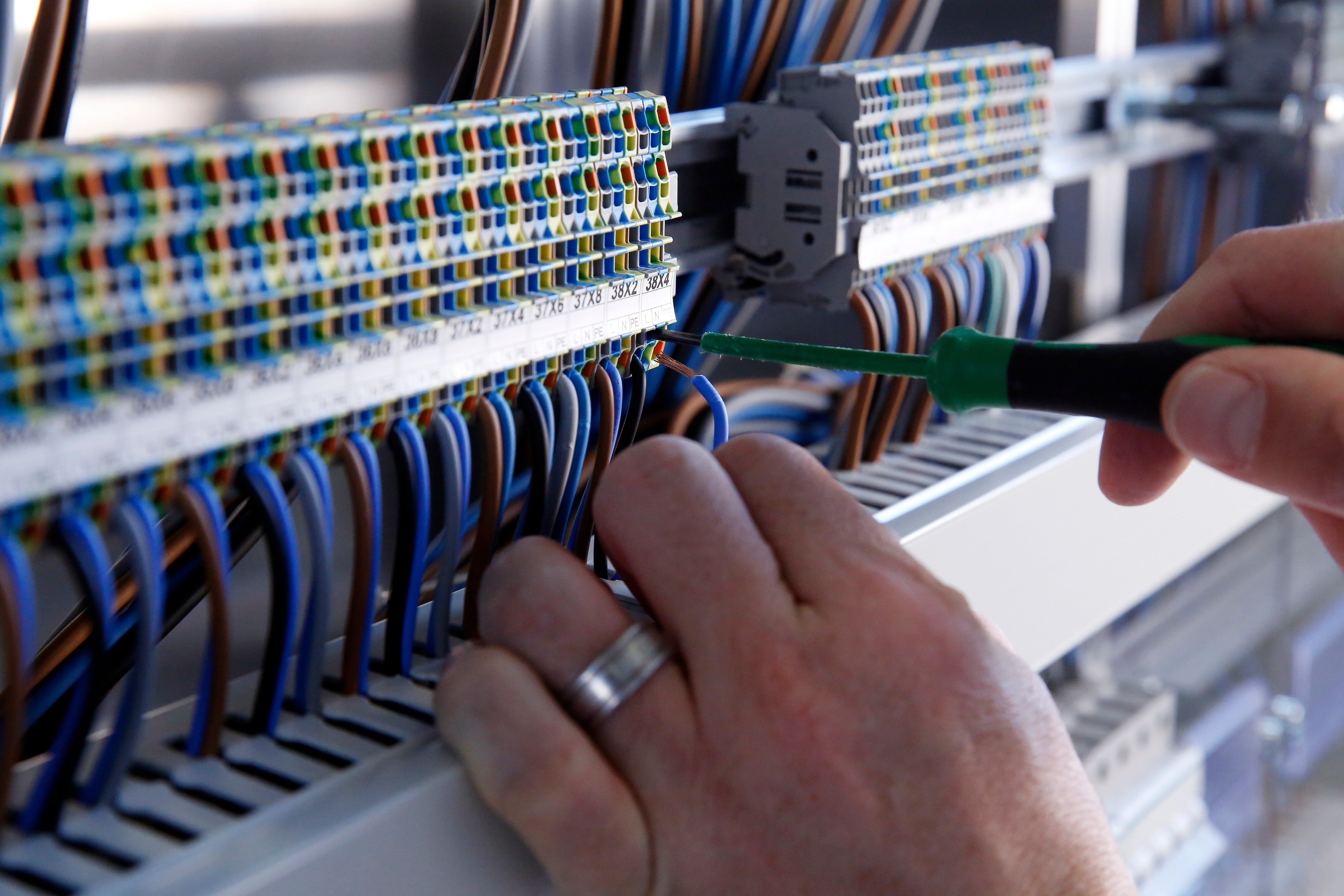
The TOPJOB® S range includes rail-mounted terminal blocks with operating slots, levers and push-buttons. Which of these terminal blocks exactly do you use?
We use the terminal blocks with operating slots and levers – the latter primarily where measurements have to be performed. In some cases, we even use the measuring disconnect terminals for this purpose, since they allow easy disconnection. More and more, we’re seeing customers wanting a testing option, even for DALI installations.
The terminal blocks are available with different cross-sections. To what extent do you benefit from this variety?
Since we’re not exclusively a controller manufacturer, we need the complete width from the smallest to the largest cross-section. On the high current terminal blocks, we connect up to 160 A with stranded wires and single conductors.
What do you think of push-in termination? As with the 2273 Series Splicing Connector, rigid conductors can also be plugged into TOPJOB® S.
As a control cabinet manufacturer, we work exclusively with screwdrivers and stranded wires on the control cabinet side. But for electricians, being able to plug in rigid conductors without tools is a very good option.
The range also includes double- and triple-deck terminal blocks, as well as various specialty terminal blocks. Which of these solutions are you familiar with?
We’re familiar with the different variants, but we avoid them ourselves as far as possible, since they make the connection situation worse for the electricians. So, when planning the switchgear combination, we always use the normal terminal block to calculate the terminal block space and really only use double-deck terminal blocks in exceptional situations.
The three-phase power set with lever and operating slot is rarely used in electrical installations, telecommunications network setup and controller manufacturing. Could you imagine using this lever terminal block for the control cabinet supply cable?
I think that’s basically a good solution. However, with the larger input modules, I find the sealing problematic, since it takes up too much space for terminal blocks with front-entry wiring. From my point of view, side-entry wiring would be a significant improvement, since it’s easier to seal the line entry from the front. For this reason, we run the supply cables to a screw-clamp terminal block so we don’t lose too much space in the depth dimension. Besides that, we don’t use screw-clamp terminal blocks.
How could you see yourself benefiting from such an optimized terminal block if you could use one?
From not needing a second product, as we clearly only want pluggable connection.
What products from the TOPJOB® S jumper range do you use?
We use the jumper range very frequently for the control potential. For example, if we have a 24 V potential or are working with MICO, we form a block with five four-wire through terminal blocks and then connect it with a push-in type jumper bar. This gives us twenty taps in a small space. We also use the jumper range in tariff controllers for electric power plants. It’s a very lean solution and easy to expand. If you don’t have enough taps, you just attach an additional terminal block and connect it with a jumper.
{"container":false,"catalogVersion":"gb-wagoContentCatalog/Online","lastExportedVersion":1,"type":"Quote Component","dynamicVisibility":true,"cloneable":true,"uuid":"eyJpdGVtSWQiOiJjb21wX2NoXzAwMDBFNUE5IiwiY2F0YWxvZ0lkIjoiZ2Itd2Fnb0NvbnRlbnRDYXRhbG9nIiwiY2F0YWxvZ1ZlcnNpb24iOiJPbmxpbmUifQ==","ignoreOnTransfer":false,"uid":"comp_ch_0000E5A9","quote":"A push-in type jumper bar allows many taps in a small space.","modifiedtime":"2026-07-11T09:00:55+0000","children":[],"onlyOneRestrictionMustApply":true,"lastLoad":1783760454986,"visible":true,"wagoColumnComponent":[],"imagePosition":"LEFT","availableLanguages":"AVAILABLE","passepartout":true,"restrictions":[],"searchable":true,"lead":"<p>Michael Bieri</p>","typeCode":"WagoQuoteTeaserComponent","slots":["eyJpdGVtSWQiOiJjc19jaF8wMDAwRDdCRSIsImNhdGFsb2dJZCI6ImdiLXdhZ29Db250ZW50Q2F0YWxvZyIsImNhdGFsb2dWZXJzaW9uIjoiT25saW5lIn0="],"itemtype":"WagoQuoteTeaserComponent","restricted":false,"name":"WagoQuoteTeaserComponent","synchronizationBlocked":true,"containers":[],"creationtime":"2025-10-13T14:58:03+0000","actions":[],"contentVersion":1,"parents":[]}
So the two jumper slots that come standard with the terminal blocks are just what you need, right?
That’s true! For expansion, we use the second slot and simply leave the existing jumper plugged in. That’s great, because it lets us expand easily even while the system is running. If we had to remove the inserted jumper, it wouldn’t be as easy.
Clean terminal block marking is like a control cabinet builder’s business card. How do you guarantee clear identification of the installed conductors?
Almost exactly the way you show in your catalogs! Our labeling spans three lines. On the bottom line we number the terminal blocks, on the middle one we indicate the X number and on the top one the load. We now have almost ten smart printers in use. We use a separate printer for each medium so we don’t have to adjust it.
{"container":false,"catalogVersion":"gb-wagoContentCatalog/Online","lastExportedVersion":1,"type":"Quote Component","dynamicVisibility":true,"cloneable":true,"uuid":"eyJpdGVtSWQiOiJjb21wX2NoXzAwMDBFNTlXIiwiY2F0YWxvZ0lkIjoiZ2Itd2Fnb0NvbnRlbnRDYXRhbG9nIiwiY2F0YWxvZ1ZlcnNpb24iOiJPbmxpbmUifQ==","ignoreOnTransfer":false,"uid":"comp_ch_0000E59W","quote":"WAGO’s thermal transfer Smart Printer can be used to quickly check whether the calculated terminal block space is sufficient.","modifiedtime":"2026-07-11T09:00:55+0000","children":[],"onlyOneRestrictionMustApply":true,"image":{"code":"_SPR4989.jpg","altText":"_SPR4989.jpg","imageFormats":[{"imageType":null,"format":"2000","url":"/medias/2000-SPR4989.jpg?context=bWFzdGVyfGltYWdlc3wyNzc4NTZ8aW1hZ2UvanBlZ3xhRFUyTDJoa1ppOHhOVEF5TVRVM05qWXhPREF4TkM4eU1EQXdYMTlUVUZJME9UZzVMbXB3Wnd8ZjBiNjk4ODBjMDIwYjllMmJmNTZiNzdlZTZmZGU4Y2E1ZDE4OGFiOThhYjZkNTc1NTM2YmQ0ZGZmMGE4MDEzOA","altText":null,"galleryIndex":null,"width":null,"description":null,"mediaType":null,"code":null},{"imageType":null,"format":"1600","url":"/medias/1600-SPR4989.jpg?context=bWFzdGVyfGltYWdlc3wxOTAyNzR8aW1hZ2UvanBlZ3xhREF3TDJoaU55OHhOVEF5TVRVM056WXdNVEExTkM4eE5qQXdYMTlUVUZJME9UZzVMbXB3Wnd8MDExMGI1OWFiNTFiMzQ1NWQ4YzU0Yzg1YzcxMWUxZTU2ZTdlY2NiNTk2YzNhZWEyMTM5YTY4YjI4YmRmMGE0Yg","altText":null,"galleryIndex":null,"width":null,"description":null,"mediaType":null,"code":null},{"imageType":null,"format":"1280","url":"/medias/1280-SPR4989.jpg?context=bWFzdGVyfGltYWdlc3wxMzMxMTZ8aW1hZ2UvanBlZ3xhR0prTDJobE1pOHhOVEF5TVRVM05qY3hOak14T0M4eE1qZ3dYMTlUVUZJME9UZzVMbXB3Wnd8MzI5OWRjN2UzOGZhNmJlM2UyMjkyNDQ0NjcwNWQzNTAyODBjZWIwYWI1NWQ4YmFmOTc4NjRhMDMwNDJlOWE5Zg","altText":null,"galleryIndex":null,"width":null,"description":null,"mediaType":null,"code":null},{"imageType":null,"format":"1024","url":"/medias/1024-SPR4989.jpg?context=bWFzdGVyfGltYWdlc3w5NTYyMHxpbWFnZS9qcGVnfGFESTFMMmhsTmk4eE5UQXlNVFUzTmpneE5EWXlNaTh4TURJMFgxOVRVRkkwT1RnNUxtcHdad3wwYjdiZGI5MWQyY2YwYTdiM2Q4ZWRhMjI2OTAxMzFkZTdjYWIyMGIxYzQwYjlkMzZjYWY4ZmQxYjVhZWU5ZWE3","altText":null,"galleryIndex":null,"width":null,"description":null,"mediaType":null,"code":null},{"imageType":null,"format":"768","url":"/medias/768-SPR4989.jpg?context=bWFzdGVyfGltYWdlc3w2NDU0MXxpbWFnZS9qcGVnfGFEaGtMMmhsT1M4eE5UQXlNVFUzTmpreE1qa3lOaTgzTmpoZlgxTlFValE1T0RrdWFuQm58ZmViMjJmZTg1NThlMjZmNWE0NWE0OWRiOTc3MzZmMTQ5ZjhmOWViMmIwZGY1MDlmMzkwMmMyMzI3NWU3ZmIzYg","altText":null,"galleryIndex":null,"width":null,"description":null,"mediaType":null,"code":null},{"imageType":null,"format":"480","url":"/medias/480-SPR4989.jpg?context=bWFzdGVyfGltYWdlc3wzODk5MHxpbWFnZS9qcGVnfGFEVmtMMmhqWWk4eE5UQXlNVFUzTnpBeE1USXpNQzgwT0RCZlgxTlFValE1T0RrdWFuQm58NjUxMDliNWIyYmJiN2E1OTAxMGFmMTljY2Y1ZWM2ZWU4Mjc1YjI1ZTNmMjNlNzBiZjM3NjQ3ZGNmODBiZjc0YQ","altText":null,"galleryIndex":null,"width":null,"description":null,"mediaType":null,"code":null},{"imageType":null,"format":"200","url":"/medias/200-SPR4989.jpg?context=bWFzdGVyfGltYWdlc3wxNjYxNnxpbWFnZS9qcGVnfGFETTRMMmhqTVM4eE5UQXlNVFUzTnpNd05qRTBNaTh5TURCZlgxTlFValE1T0RrdWFuQm58YTMyM2ZmNjYyNDY3OTgyMDc3NzEyYjAzN2M1MWMwYTNmNzAxMWMzOWI3M2YyNjgyZmFhYjQ3OWIyZjNmNTg5MQ","altText":null,"galleryIndex":null,"width":null,"description":null,"mediaType":null,"code":null}],"description":"_SPR4989.jpg"},"lastLoad":1783760455437,"visible":true,"wagoColumnComponent":[],"imagePosition":"LEFT","availableLanguages":"AVAILABLE","passepartout":true,"restrictions":[],"searchable":true,"lead":"Michael Bieri","typeCode":"WagoQuoteTeaserComponent","slots":["eyJpdGVtSWQiOiJjc19jaF8wMDAwRDdCRSIsImNhdGFsb2dJZCI6ImdiLXdhZ29Db250ZW50Q2F0YWxvZyIsImNhdGFsb2dWZXJzaW9uIjoiT25saW5lIn0="],"itemtype":"WagoQuoteTeaserComponent","restricted":false,"name":"WagoQuoteTeaserComponent","synchronizationBlocked":true,"containers":[],"creationtime":"2025-10-13T14:58:03+0000","actions":[],"contentVersion":1,"parents":[]}
Why don’t you give us two or three specific examples of how you use the Smart Printer?
We use a printer for labeling the terminal blocks, for example. Another example is the labeling of individual markers; we even use those to mark third-party products. We print the silver labels for door installations on an additional Smart Printer. In my opinion, there’s no better way to clearly label terminal blocks. You’ve provided a fantastic solution, and your marking system is also the reason we switched to WAGO.
You sound really convinced!
I also like the fact that, with the Smart Printer, we can check whether the calculated terminal block space is really sufficient within a few seconds. To do this, we just leave the marking strip off before assembly. Then whoever’s in charge can just hold the strip up to the control cabinet and immediately see whether the planning was correct. In the past, sometimes we’d place the terminal blocks, and after 80 percent of the work was done, we’d realize that the available space was insufficient. And this verification mechanism involves no extra effort for us, since we’d have to print out the marking strip anyway.
How do you get the data from the circuit diagram to the Smart Printer? Do you use a CAE system, or maybe even the Excel import function?
We use the Excel import function, but only to a very limited extent, since we often don’t get the data from the planning stage at all. When we’re the ones drawing the diagram, that’s all set and works just fine. But with most of the circuit diagrams we get from outside sources, we have to copy it manually in the workshop.
Do you have any other thoughts about control cabinet engineering with TOPJOB® S, either positive or negative?
Your larger cross-section connection terminal blocks are relatively bulky. But that’s really the only criticism that occurs to me off the top of my head. Besides that, we’re very satisfied with TOPJOB® S, and it’s increased our efficiency enormously. My coworkers in the workshop can confirm that. Availability is another aspect we’re extremely happy with – if we need something in a hurry, we can count on it being available from the wholesaler.