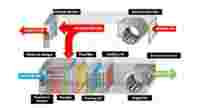
An AHU is an integrated collection of components that are sized to provide the required heating and cooling based on the relevant building code, engineering calculations and the design requirements of the end user. Some examples are peak demand cooling/heating load, filtration, volumetric flow rate, temperature and moisture levels.
The term “air handling unit” encompasses equipment for many different applications. AHUs range in size and complexity from small, rooftop-mounted units providing HVAC to a shop or small office. This type of equipment has basic components for heating/cooling and controls: dampers, filters and a fan with little or no control other than a wall-mounted thermostat.
In contrast, AHU equipment serving buildings such as hospitals, data centers, laboratories and specialized manufacturing facilities have extremely precise setpoint parameters, multiple levels of filtration, redundant fans and motors and very complex control and instrumentation systems.
The type of air-handling systems will determine which (if any) EEM can be used to calculate energy savings.
- AHU type (rooftop unit, heat pump, packaged indoor AHU).
- Heating source (electric resistance, direct/indirect gas, hot water, reverse cycle).
- Type of cooling (compressors, chilled water, reverse cycle).
Measures don’t have to apply to the entire AHU. Many are written for sub-systems of the air handling equipment, for example:
- Integrated control of dampers for optimizing discharge air temperature, demain-controlled ventilation and outdoor air economizer.
- Outside air damper: Damper for bringing outside air; depends on control strategy for ventilation, pressurization and economization.
- Return air damper: Damper for controlling airflow back to the AHU.
- Exhaust damper: Damper to control amount of exhaust air.
Based on the existing type of filtration, there could be opportunities to reduce pressure drop across the filter section:
- Filtration: Study the feasibility to remove existing filters and install low-pressure drop filters using polarized media.
- Investigate application of advanced controls (especially for rooftop units) to control fan speed, damper positions, indoor air quality and optimized start stop.
- Supply fan: Ensures proper airflow rates.
- Return or return/exhaust fan: Works in conjuction with supply fan to return/exhaust.
- Exhaust fan: A dedicated fan to extract air from the building to maintain ventilation and pressurization requirements.
While the items listed above are presented as induvial items, some measures are based on an integrated approach, taking many of the elements in total. It just depends on the measure.
Compressors are the primary component in the refrigeration cycle. They are used are used in residential, commercial, institutional and industrial cooling processes. Yet all AHUs that rely on compressorized systems are based on the same basic concept. A compressed refrigerant cools air or other fluids as required by the specific process. The outdoor temperature and relative humidity have a big impact on the energy use of the process and will vary considerably depending on the climate zone.
In hot climates (dry and humid) air conditioning is one of the primary energy consumers especially in commercial buildings. Energy-efficiency programs in these states have a much greater focus on air conditioning systems including compressor power and fan energy. This is an opportunity for end-users to apply for utility programs and get partial funding for system upgrades.
Installing heat pumps can result in lower heating and cooling costs. This technology hinges on the climate and the savings will differ depending on the location of the installation. A measure that is based on replacing packaged AHUs with heat pumps may be applicable to warmer climates and locations due to the ambient limitations of heat pumps.