[{"term":"Libraries_BA","id":0,"type":"QUICKLINKS"},{"term":"Instructions","id":1,"type":"QUICKLINKS"},{"term":"WAGO-I/O-PRO","id":2,"type":"QUICKLINKS"},{"term":"Building","id":3,"type":"QUICKLINKS"},{"term":"221","id":4,"type":"QUICKLINKS"}]
{ "@context": "https://schema.org", "@type": "BreadcrumbList", "itemListElement": [ { "@type": "ListItem", "position": 1, "name": "Homepage", "item": "https://www.wago.com/global" }, { "@type": "ListItem", "position": 2, "name": "Industry Solutions", "item": "https://www.wago.com/global/industries" }, { "@type": "ListItem", "position": 3, "name": "Power Engineering ", "item": "https://www.wago.com/global/power-engineering" }, { "@type": "ListItem", "position": 4, "name": "Renewable Energy Generation", "item": "https://www.wago.com/global/power-engineering/renewable-energy-generation" }, { "@type": "ListItem", "position": 5, "name": "Customer Application", "item": "https://www.wago.com/global/power-engineering/renewable-energy-generation/customer-application-multilingual-transformer-station" } ] } [{"url":"/industries","name":"Industry Solutions","linkClass":null,"categoryCode":null},{"url":"/power-engineering","name":"Power Engineering ","linkClass":null,"categoryCode":null},{"url":"/power-engineering/renewable-energy-generation","name":"Renewable Energy Generation","linkClass":null,"categoryCode":null},{"url":"/power-engineering/renewable-energy-generation/customer-application-multilingual-transformer-station","name":"Customer Application","linkClass":"active","categoryCode":null}]
Customer application

The Multilingual Transformer Station
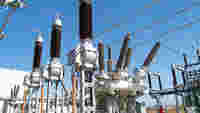
The security of the power supply can be easily endangered – for example, when an overly enthusiastic backhoe operator damages electrical lines during an excavation. In such cases, a fast and, above all, targeted diagnosis of the electrical grid is essential, both along long spans and also in the distributed transformer stations. In the transformer station in the Wittmund wind farm, ENERCON relies on the WAGO PFC200 Telecontroller for signal processing and data transmission.
ENERCON, headquartered in Aurich in northern Germany, is among the international technological leaders, with more than 26,300 wind turbines. In Wittmund, ENERCON constructed the facility, and it also operates the wind farm and transformer station. “There is increasing demand for turnkey solutions for wind farms from a single source, from planning, to construction, to supplying the electrical grid,” explains Gerd-Evert Meyer, Project Manager at ENERCON. Consequently, the company is seriously considering how to link wind farms into the smart grid and, above all, how to ensure the availability and monitoring of the systems, including the transformer stations.

The Benefits of WAGO for You:

  • The WAGO PFC200 Telecontroller provides security through uninterrupted monitoring
  • Enables fast, targeted fault diagnosis
  • Is freely programmable via CODESYS

The Heart of the Communication

With this goal in mind, the WAGO PFC200 Telecontroller plays a central communication role in the transformer station. First, it establishes the link between the network operator and the wind farm controller. It’s important to understand that the network operator uses a different language than is used within the wind farm and between the facility and its operator – namely ENERCON. The multiple languages are a result of different protocol standards for telecontrol technology. A serial, point-to-point connection, based on IEC 60870-5-101, is established between the network operator and the wind farm regulator. The data to be transmitted typically consists of requests for active power or reactive power. In addition to the acknowledgment of the setpoints, the actual output, wind strengths and additional weather data are then sent back “to make it possible to derive the output capability of the wind farm,” explains Meyer.

In contrast, IP communication between the wind farm controller, the ENERCON control center and the PFC200 uses the “dictionary” of IEC 60870-5-104. “For us, the WAGO controller represents the largest communication node in the transformer station, and it manages everything,” explains the project manager. A third protocol, using IEC 60870-5-103, connects the technology within the transformer station. 103 communication represents the official standard in Europe for transmitting messages to digital protective equipment in the station control system. The protective devices can be understood here as slaves that transmit data cyclically or at the request of the master. In addition, signals are also received via digital inputs. Typical signals in a transformer station include door closure contacts, switch monitors and fill level or pressure sensors.

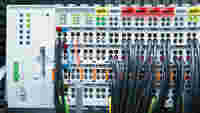
energy_referenz_controller_module_750-8202-025-001_2000x1125.jpg

The PFC200 Telecontroller plays a central communication role in the transformer station.